
The Future of Church Communication: Why AI-Powered Automation Is Becoming Essential
It’s 9:52 on Sunday morning. The announcement slide is still blank, the reminder text never went out, and someone just quietly asked whether the VBS graphic ever got posted. If that sentence made you wince a little, this article is for you.
The Communication Challenge Nobody Talks About
Most churches do not have a communications department. They have a person.
That person may be an executive pastor, a ministry director, an administrative assistant, a worship leader, a children’s pastor, or a volunteer who simply stepped up because someone needed to handle communication.
They were hired for one role. But somewhere along the way, communication became part of their job description. Now they are responsible for:
- Writing emails
- Sending text reminders
- Creating social media posts
- Updating the website
- Promoting events
- Managing registrations
- Following up with guests
- Communicating with volunteers
- Creating announcements
- Keeping everyone informed
They are not a communications team. They are one person wearing ten different hats. And while they love the church and the mission, communication has become one more responsibility competing for their time.
This is the reality facing many churches today.
They are not a communications team. They are one person wearing ten different hats.
Communication Has Changed
The way people receive information has changed dramatically. A Sunday announcement is no longer enough. People expect communication through:
A single church event now requires multiple communication touchpoints. A church outreach event, for example, might need:
- A website description
- Registration information
- Email invitations
- Reminder texts
- Social media posts
- Volunteer instructions
- Follow-up communication
The event itself may be simple. The communication around the event is not.
The Problem Isn’t a Lack of Vision. It’s a Lack of Capacity.
Churches are filled with incredible ministries. There are stories to tell. People to reach. Lives to impact.
But often, the communication system cannot keep up with the mission. Not because churches do not care — because the people responsible for communication are already carrying full plates.
The question is no longer “How do we create more content?”
The better question is “How do we build a communication system that helps us consistently reach people?”
The Rise of AI-Powered Church Communication
Artificial intelligence is changing the way organizations approach communication. For churches, AI is not about replacing people. It is about removing unnecessary workload so people can focus on ministry.
AI can help churches:
- Create communication faster
- Repurpose content across platforms
- Build communication workflows
- Personalize messages
- Improve consistency
- Automate follow-up
The goal is not a more automated church. The goal is a more connected church.
Introducing Shofar: Church Communication Automation Powered by AI
Shofar was built for the reality most churches experience. Not every church has a communications director. Not every church has a marketing team. But every church has something worth communicating.
Shofar helps churches turn ministry moments into complete communication strategies. Create an event once, and generate communication for multiple channels, including:
We call this a church communication operating system: one system that plans, drafts, and coordinates every message tied to a ministry moment — email, text, social, and beyond — so reaching people doesn’t depend on one person remembering everything.
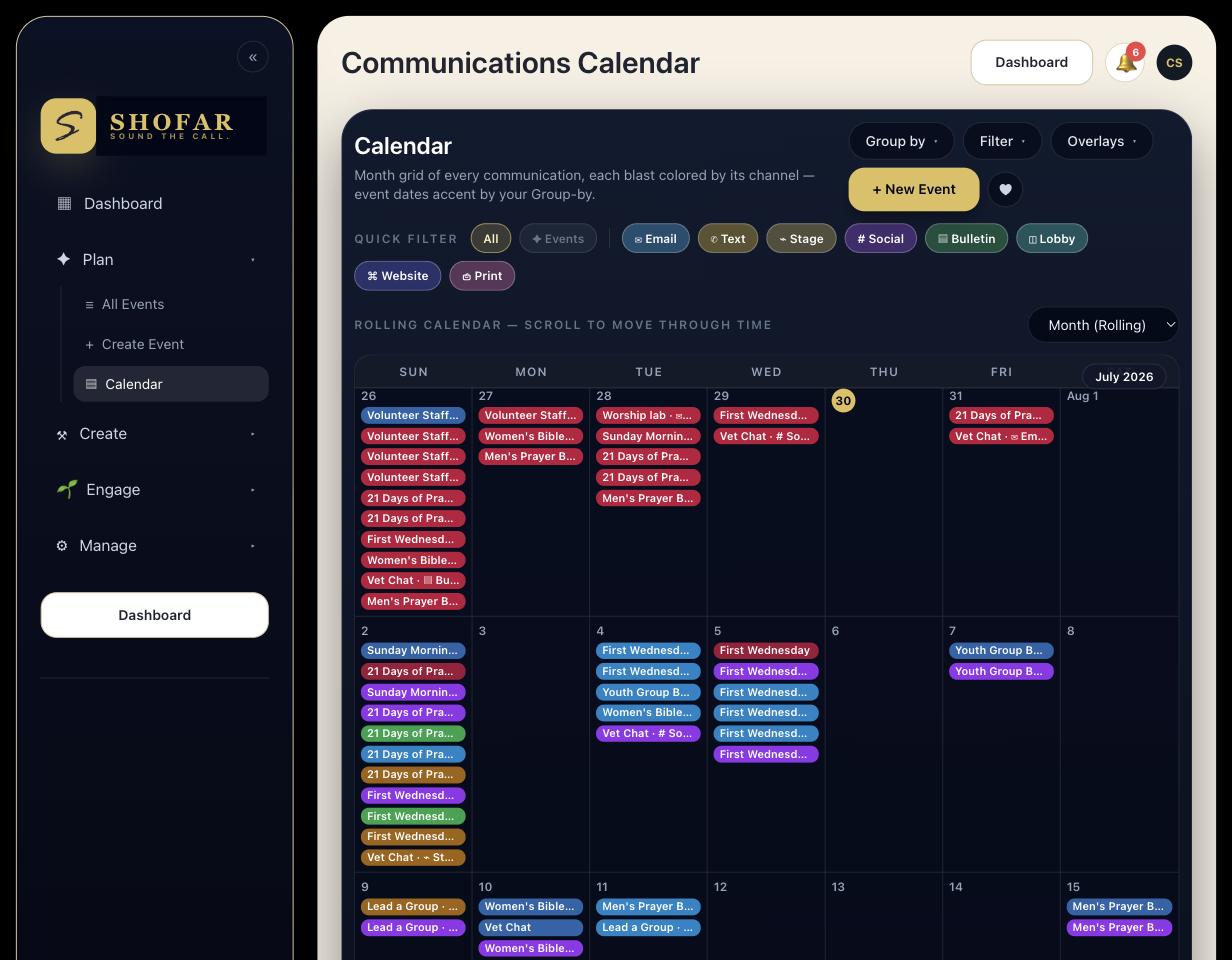
Every message remains editable, because the voice of the church matters. AI helps create the communication. Church leaders provide the mission, personality, and heart.
The Future of Church Communication
The future of church communication is not about churches creating more announcements. It is about churches building better systems.
AI-powered communication automation gives churches the ability to communicate with greater consistency, clarity, and intentionality.
The message of the church has not changed. The mission has not changed. But the tools available to communicate that message are evolving — and they’re available today.
Frequently Asked Questions
Is AI going to replace our church’s communication team?
What is a “church communication operating system”?
Do I need a marketing background to use AI church communication tools?
Ready to see it for your church?
Start your 14-day free trial today and see what Shofar can do for your church this Sunday.
- 14-day free trial, card required to start
- Hands-on support from our team while you get set up
- Cancel anytime — no long-term contract